
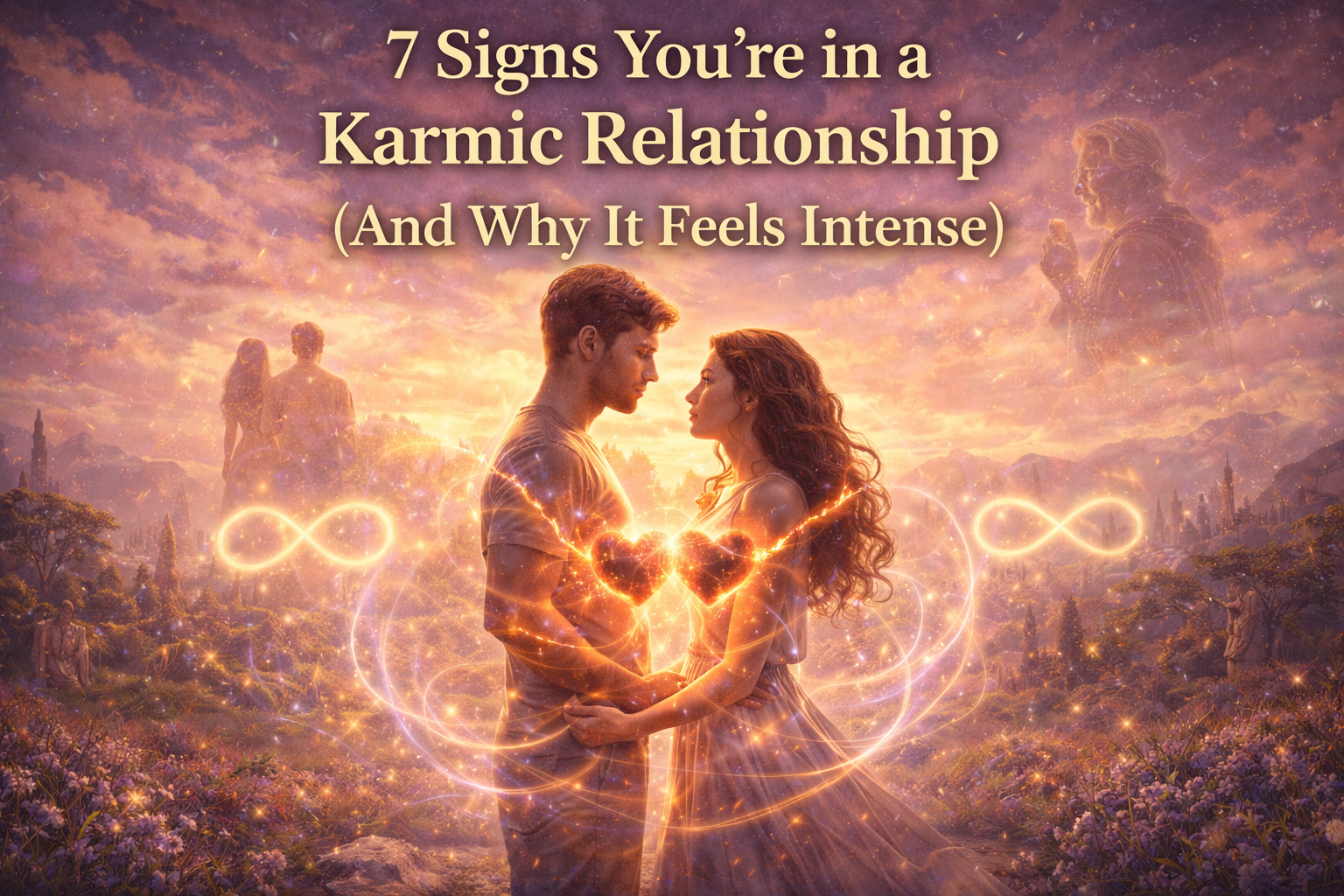
Some relationships feel different from the very beginning. The connection is immediate, powerful, and almost overwhelming. You may feel like you’ve known the person forever — even if you just met. At the same time, the relationship can be emotionally intense, complicated, and difficult to navigate.
Many spiritual traditions describe these experiences as karmic relationships. Understanding the karmic relationships signs can help you determine whether your connection is part of a deeper soul lesson — and what it means for your growth.
What Is a Karmic Relationship?
A karmic relationship is believed to be a connection between two souls who share unresolved energy from past experiences — possibly even past lives. These relationships are not random. They are said to exist to teach important lessons about love, boundaries, responsibility, or self-worth.
Unlike stable, long term partnerships built on harmony, karmic relationships are often intense and transformative. Their purpose is growth — not comfort.
Why Do Karmic Relationships Feel So Intense?
The intensity comes from unfinished emotional energy. When two people reconnect with unresolved patterns, it can trigger powerful emotions such as:
- Obsession
- Deep attachment
- Fear of loss
- Jealousy
- Emotional highs and lows
This intensity isn’t necessarily toxic but it does feel overwhelming because it pushes you to confront parts of yourself you may have avoided.
7 Clear Karmic Relationships Signs
If you’re wondering whether you’re in a karmic relationship, here are the most common signs to look for.
1. Instant, Magnetic Attraction
One of the strongest karmic relationships signs is immediate chemistry. You may feel drawn to the person without logical explanation. The connection feels familiar, almost like reconnecting with someone you already know.
This familiarity can create both comfort and urgency — as if something important must happen between you.
2. Emotional Highs and Lows
Karmic relationships rarely feel neutral. They often swing between intense closeness and emotional distance. Arguments may feel dramatic. Reconciliations may feel euphoric.
This rollercoaster dynamic happens because unresolved emotional lessons are being activated.
3. Repeating Conflicts
If the same arguments keep resurfacing despite attempts to resolve them, it may signal a karmic lesson. The issue isn’t the surface problem — it’s the underlying pattern.
Common repeating themes include:
- Trust issues
- Control struggles
- Fear of abandonment
- Power imbalance
Until the lesson is understood, the conflict tends to repeat.
4. Feeling “Addicted” to the Relationship
Another common karmic relationships sign is difficulty letting go — even when the relationship is painful.
You may know logically that it isn’t healthy, but emotionally you feel attached. This attachment often stems from unresolved energetic bonds rather than compatibility alone.
5. The Relationship Triggers Deep Personal Growth
Despite the challenges, karmic relationships often push you to grow rapidly. You may discover:
- Hidden insecurities
- Childhood wounds
- Patterns of self-sabotage
- Boundary issues
Although uncomfortable, this growth is part of the relationship’s purpose.
6. Strong Sense of Unfinished Business
Even after separation, karmic partners may reappear unexpectedly. The connection can feel incomplete, as if something still needs closure.
This lingering energy is one of the clearest karmic relationships signs — it suggests a lesson hasn’t fully integrated yet.
7. The Relationship Changes You Permanently
Whether it lasts months or years, a karmic relationship rarely leaves you unchanged. It shifts your understanding of love, yourself, and your emotional needs.
Once the lesson is learned, you often feel stronger, wiser, and more self-aware.
Karmic Relationship vs Soulmate: What’s the Difference?
People often confuse karmic relationships with soulmates, but they serve different purposes.
| Karmic Relationship | Soulmate Relationship |
|---|---|
| Intense and turbulent | Supportive and balanced |
| Focused on lessons | Focused on harmony |
| Often temporary | Often long-term |
| Emotionally triggering | Emotionally safe |
A karmic relationship teaches through challenge. A soulmate relationship grows through mutual stability.
Are Karmic Relationships Always Romantic?
No. Karmic relationships can also appear as:
- Family members
- Close friends
- Business partners
- Mentors
Any relationship that triggers strong emotional patterns and deep personal lessons may carry karmic energy.
How to Handle a Karmic Relationship
If you recognize multiple karmic relationships signs in your situation, the goal is not to panic — it’s to gain awareness.
1. Identify the Core Lesson
Ask yourself:
- What pattern keeps repeating?
- What emotion feels strongest?
- What is this relationship teaching me about myself?
2. Set Healthy Boundaries
Karmic growth does not require emotional suffering. Boundaries help break unhealthy cycles.
3. Take Responsibility for Your Part
Blame keeps karmic loops active. Ownership creates change.
4. Release When the Lesson Is Complete
Some karmic relationships end naturally once both individuals grow beyond the pattern.
Can Karmic Relationships Become Healthy?
Sometimes — but only if both individuals become conscious of the pattern. Without awareness, karmic dynamics continue repeating.
Healing requires:
- Emotional maturity
- Honest communication
- Willingness to grow
If growth is one-sided, the relationship may not stabilize.
Final Thoughts: Understanding Karmic Relationships Signs
Karmic relationships are not punishments — they are catalysts. They reveal unresolved emotional patterns and push you toward deeper self-awareness.
When you recognize the karmic relationships signs, you move from confusion to clarity. Instead of asking “Why is this happening to me?” you begin asking “What is this teaching me?”
Growth is the ultimate purpose.

Michael Smith is a spiritual content writer and independent researcher who explores topics such as past life studies, reincarnation, karma, dream symbolism, and spiritual self-discovery. His work focuses on presenting ancient beliefs, metaphysical concepts, and modern interpretations in a clear, balanced, and reader-friendly way.
With a strong interest in spiritual psychology and comparative belief systems, Michael creates informative articles designed to help readers reflect, learn, and form their own understanding. He emphasizes clarity, transparency, and responsible discussion of spiritual topics, aligning his content with Google’s EEAT (Experience, Expertise, Authoritativeness, and Trustworthiness) and Helpful Content guidelines.
Michael’s articles are written for educational and informational purposes, drawing from historical references, cultural traditions, and widely discussed spiritual theories. He avoids exaggerated claims and encourages readers to approach spiritual exploration with curiosity, mindfulness, and personal discernment.
When not writing, Michael continues researching spiritual traditions, symbolism, and consciousness studies to deliver thoughtful, high-quality content that supports meaningful learning and self-reflection.
About The Author